How to Help a Dog Who Barks at the Door needs a plan that is useful in ordinary life and honest about its limits. For How to Help a Dog Who Barks at the Door, this guide takes a specific route: create a two-track plan: immediate arrival management and gradual door-sound training; it uses reward-based teaching, environmental management, and observable stop rules. While evaluating How to Help a Dog Who Barks at the Door, the guidance is educational, not a diagnosis or a promise that every dog will progress on the same timetable.
Map the Doorbell Sequence
Break the event into sound, movement toward the door, sight of a person, opening, and entry. Identifying where arousal first rises tells you where a training repetition should begin.
Use map the doorbell sequence to improve the next decision, not to attach a permanent label to the dog. For Map the Doorbell Sequence, look at what happened before, the dog's whole body, available choices, the immediate consequence, and the time needed to recover; one observation suggests a hypothesis; a repeated pattern across comparable situations provides stronger guidance. While evaluating Map the Doorbell Sequence, avoid staging a trigger to obtain cleaner evidence; if uncertainty affects safety, increase distance or use a barrier first and ask a qualified professional to assess the context directly.
Manage Sight, Sound and Access
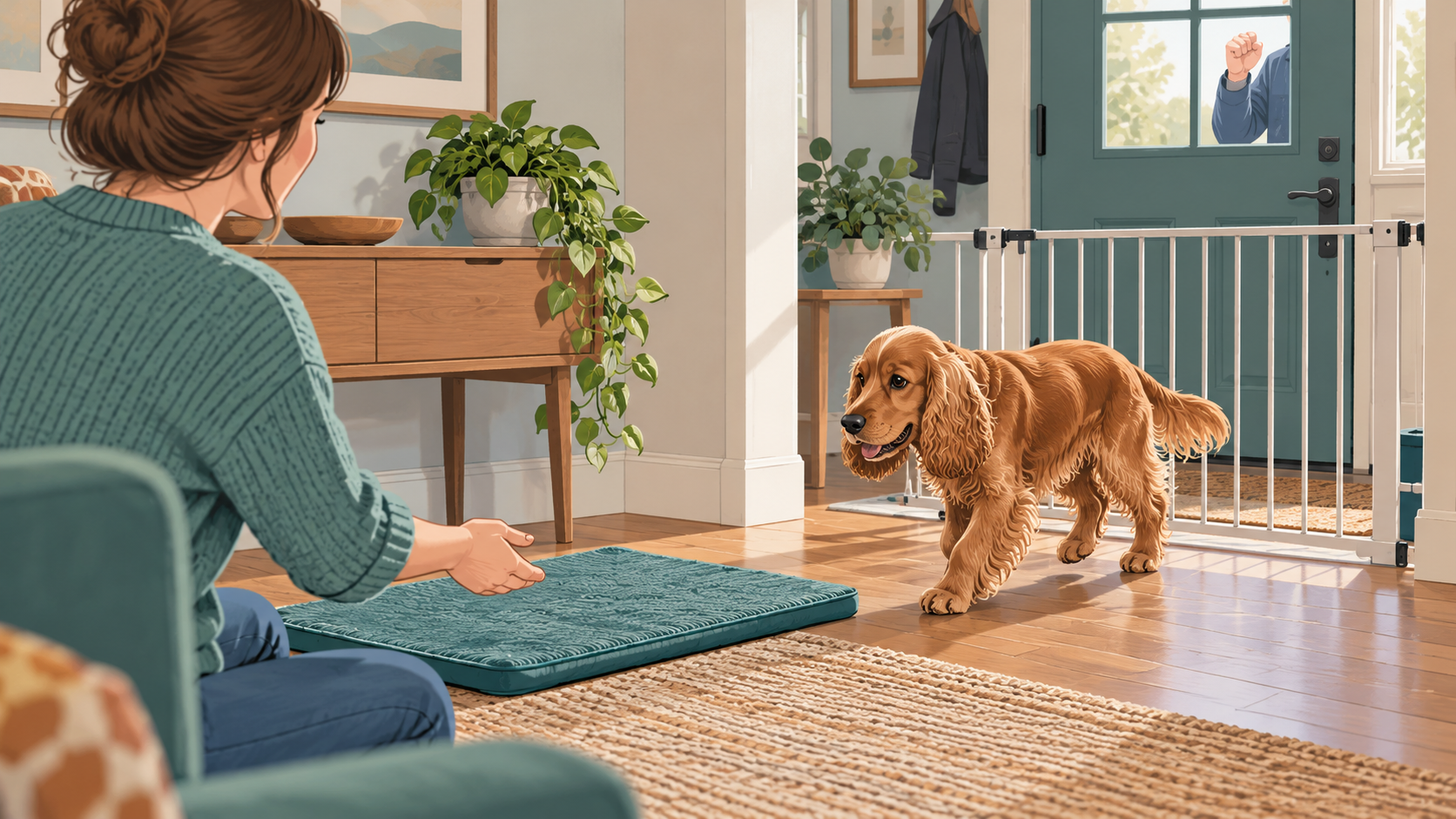
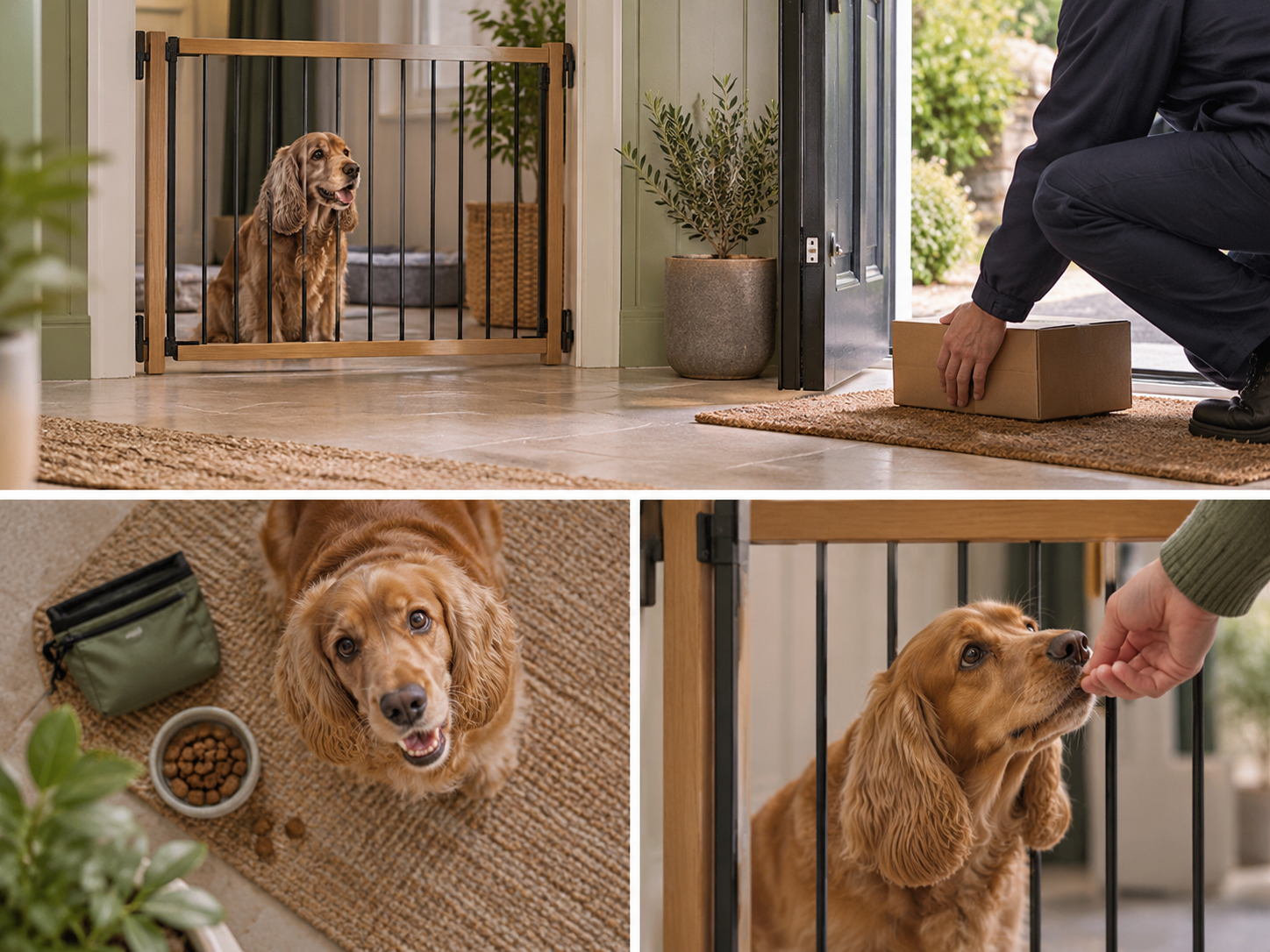
Use visual film, a white-noise source, a gate, a leash prepared in advance, or delivery instructions to reduce surprise. Keep the dog away from the opening door while the new routine is still fragile.
Apply manage sight, sound and access below the point where the dog loses the ability to disengage or recover. For Manage Sight, Sound and Access, management should stop repeated exposure while the response is being understood, and any practice should begin with generous distance, short duration, and a clear exit; record the trigger and recovery instead of describing the dog as stubborn, dominant, or guilty. While evaluating Manage Sight, Sound and Access, if body language becomes still, frantic, threatening, or difficult to interrupt, end the setup calmly and strengthen the safety plan before another attempt.
Teach a Station Away From the Door
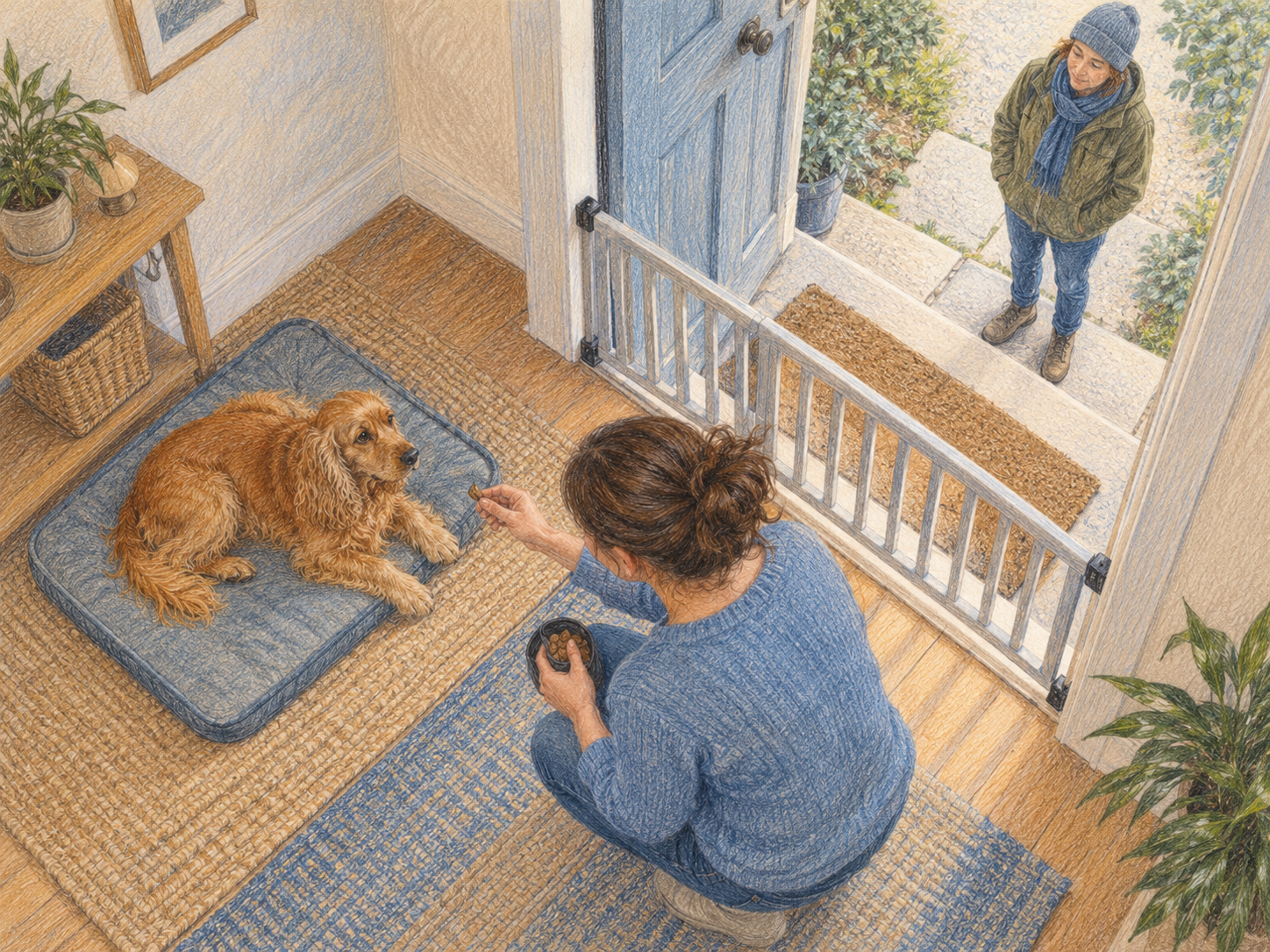
Choose a mat or room several steps from the entrance and build value there when the house is quiet. Reinforce going to the station, remaining briefly, and returning after release as separate skills.
Apply teach a station away from the door below the point where the dog loses the ability to disengage or recover. For Teach a Station Away From the Door, management should stop repeated exposure while the response is being understood, and any practice should begin with generous distance, short duration, and a clear exit; record the trigger and recovery instead of describing the dog as stubborn, dominant, or guilty. While evaluating Teach a Station Away From the Door, if body language becomes still, frantic, threatening, or difficult to interrupt, end the setup calmly and strengthen the safety plan before another attempt.
Rehearse With Controlled Door Sounds
Play a low-volume recording or make a very soft knock, then cue the station and reward. Raise volume or realism only when the dog can hear the sound and still eat, orient, and recover.
Apply rehearse with controlled door sounds below the point where the dog loses the ability to disengage or recover. For Rehearse With Controlled Door Sounds, management should stop repeated exposure while the response is being understood, and any practice should begin with generous distance, short duration, and a clear exit; record the trigger and recovery instead of describing the dog as stubborn, dominant, or guilty. While evaluating Rehearse With Controlled Door Sounds, if body language becomes still, frantic, threatening, or difficult to interrupt, end the setup calmly and strengthen the safety plan before another attempt.
Bring in a Helper Gradually
A helper can approach, pause, retreat, and eventually enter according to the dog's response. One variable should change at a time; adding a louder knock, faster entry, and unfamiliar person together hides what caused failure.
Apply bring in a helper gradually below the point where the dog loses the ability to disengage or recover. For Bring in a Helper Gradually, management should stop repeated exposure while the response is being understood, and any practice should begin with generous distance, short duration, and a clear exit; record the trigger and recovery instead of describing the dog as stubborn, dominant, or guilty. While evaluating Bring in a Helper Gradually, if body language becomes still, frantic, threatening, or difficult to interrupt, end the setup calmly and strengthen the safety plan before another attempt.
Safety Plan for Real Deliveries
For genuine deliveries, prioritize a closed barrier and complete the handoff before training. If there is lunging, attempted biting, or a history of contact, do not use visitors as practice partners without professional guidance.
Apply safety plan for real deliveries below the point where the dog loses the ability to disengage or recover. For Safety Plan for Real Deliveries, management should stop repeated exposure while the response is being understood, and any practice should begin with generous distance, short duration, and a clear exit; record the trigger and recovery instead of describing the dog as stubborn, dominant, or guilty. While evaluating Safety Plan for Real Deliveries, if body language becomes still, frantic, threatening, or difficult to interrupt, end the setup calmly and strengthen the safety plan before another attempt.
The Practical Takeaway
For How to Help a Dog Who Barks at the Door, progress should make the next repetition clearer and safer, not merely more difficult. For How to Help a Dog Who Barks at the Door, keep the last easy success available, change one condition at a time, and let the dog's comfort and recovery set the pace; use physical management anywhere a mistake could cause harm. While evaluating How to Help a Dog Who Barks at the Door, when pain, panic, aggression, escape risk, or sudden behavioral change enters the picture, pause the home experiment and bring specific observations to a veterinarian or appropriately qualified behavior professional.
One More Planning Pass
Before using How to Help a Dog Who Barks at the Door in a harder setting, write a one-line plan covering the trigger or cue, the exact response you will reinforce, the reward, the physical safety backup, and the signal that ends the session. For How to Help a Dog Who Barks at the Door, the article's distinctive purpose remains important: Create a two-track plan: immediate arrival management and gradual door-sound training; begin where success is highly likely, watch the whole dog between repetitions, and keep enough distance or containment to prevent a mistake from becoming dangerous. While evaluating How to Help a Dog Who Barks at the Door, review the notes after several short practices; increase only the variable that stayed easy, keep every other feature stable, and return to the earlier version as soon as recovery slows. In the context of How to Help a Dog Who Barks at the Door, that simple review protects both learning quality and welfare.
Make the plan concrete enough that another adult could follow it without improvising. For How to Help a Dog Who Barks at the Door, name the room or route, prepare barriers or equipment, choose rewards that are safe for the dog, and decide how many repetitions will be attempted before a break; include a fallback that does not depend on the dog responding to a cue, because management must still work on a difficult day. While evaluating How to Help a Dog Who Barks at the Door, record what the dog noticed, whether the intended response occurred, and how long recovery took; those observations should determine the next session. In the context of How to Help a Dog Who Barks at the Door, do not increase several demands just because one repetition looked easy, and do not continue through fear, pain, frantic behavior, aggression, or repeated attempts to escape.